You have a story. It’s an important one, and it’s set right here in Scotland, maybe in the narrow closes of Edinburgh, the industrial heart of Glasgow, or the vast, cinematic landscapes of the Highlands. You know this story needs to be told. But where do you even begin?
Making a documentary is one of the most rewarding, challenging, and powerful things you can do. It’s a craft of passion, but it’s also a complex logistical and technical process.
As a filmmaker, I’ve seen countless brilliant ideas fail. Not because the story was weak, but because the process was broken. This guide is the blueprint I wish I had when I started. It’s not a secret formula, but a proven, step-by-step process.
We will cover everything: finding your story, gaining access, the legal essentials, the craft of filming, the magic of editing, and finally, getting your film to an audience. This is the complete guide to producing your first documentary in Scotland.
This is the single most important phase. A documentary with a weak story, no matter how beautifully filmed, will fail. A great story, even with technical flaws, will find an audience.
Most first-time filmmakers make a critical mistake: they confuse a topic with a story.
“The housing crisis in Edinburgh” is a topic. It’s broad, abstract, and you can’t film it.
“A single mother of three in Leith who has 30 days to find a new home before being evicted” is a story. It has a character, a ticking clock, high stakes, and a central conflict.
Your unique perspective is your greatest asset. Don’t just look for a subject; find your angle on it.
The quickest way to see if you have a story is to frame it as a question.
Here are some examples of how to transform a broad topic into a compelling, filmable question.Topic: The Edinburgh Fringe Festival.
Bad Question: “What is the Fringe like?”
Good Question: “Can a first-time comedian sink her life savings into one show at the Fringe and find an audience before she goes broke?”
Topic: Fishing in the North Sea.
Bad Question: “What is the life of a fisherman?”
Good Question: “Must a third-generation Peterhead fisherman choose between selling his father’s struggling boat and adopting new, sustainable methods that his community rejects?”
Topic: The Scottish Highlands.
Bad Question: “What is life in the Highlands like?”
Good Question: “Can a young couple from Glasgow, with no experience, successfully build an off-grid croft in the Highlands while battling both the ancient landscape and 21st-century planning laws?”
A good question has a character, a goal, and high stakes. That is what you can build a film around.
Grab a notebook and answer these questions. This is how you find your story.
What am I obsessed with? What is a topic I’ve been interested in for years? Your genuine passion is not something you can fake, and it’s what will sustain you through the project.
What is the conflict? All stories are about conflict. This can be internal (a character battling an addiction) or external (a community fighting a developer). No conflict, no story.
What is the central question? What question is your main character wrestling with? (e.g., “Will I be able to save my family’s 100-year-old shop?”).
Do I have access? Is there a character at the heart of this who will let me in? Access is everything. A good story with no access is not a film.
Pre-production is where your film is truly made. A great film is built on deep preparation. This phase is about building your structural roadmap and, most importantly, building human relationships.
Your relationship with your subject is the heart of the documentary.
The Initial Approach: Be short, succinct, and transparent. Express your genuine passion for their story. The goal is not to get a “yes” on the first email, but to get a low-pressure conversation.
The First Meeting: This is my single most important piece of advice: Leave the camera in the car. Meet them as a human, not a filmmaker. A camera is an object that takes; you want to build a relationship that gives. Ask questions. Be inquisitive. Show you care about them, not just their “story”.
You are not stealing a story; you are being trusted with one. Be transparent. Discuss the film’s themes, the style you’re thinking of, and the key moments you believe are important.
When your subject understands the vision, they become an ally. They become a “co-director”. They will call you and say, “That thing we talked about is happening next week. You need to be here.” That is when you know you have the trust you need.
Even for an unscripted film, you must have a roadmap. You can’t plan every scene, but you can map out the journey.
Act I: The Setup. You introduce your character, their world, and their “want” or “need.” You establish the central question of the film. (e.g., “We meet a North Sea fisherman in Peterhead who is struggling to keep his father’s boat afloat.”)
Act II: The Confrontation. This is the journey. What are the obstacles and antagonists your character must face? (e.g., Rising fuel costs, new regulations, a family illness, a terrible storm.) This is where you will spend most of your filming time.
Act III: The Resolution. How does the journey end? You can’t predict it, but you can brainstorm the possible outcomes. The character either achieves their goal, fails, or, most often, returns to their life, changed by the journey.
This is the boring part that will save your film. Do not skip this. Get your paperwork in order from day one.
This is the boring part that will save your film. Do not skip this. Get your paperwork in order from day one.
Basic Release Forms: You need one from everyone who is identifiable on camera. A release form grants you permission to film them and use their likeness in your project. Carry copies with you at all times.
Location Releases: If you are filming on private property (like an office, a shop, or a home), you need a form signed by the owner.
Archival & Music Rights: If you plan to use old photos, home videos, or a commercial song, you must clear the rights. This can be complex and expensive.
Public Spaces: You are generally free to film in public places (streets, parks, squares) for non-commercial purposes. However, in cities like Edinburgh and Glasgow, if you are using a large crew and tripod, you may need to check with the local council film office.
Private Land: Scotland’s “Right to Roam” is generous, but it does not include filming for commercial purposes on private land. Always seek the landowner’s permission.
Drone Filming: Do not even think about flying a drone without being fully compliant with the Civil Aviation Authority (CAA) regulations. The rules are strict, especially in cities and near airports (like Edinburgh and Glasgow). Using a licensed operator is almost always the correct, professional, and legal choice.
This is the “shoot.” This is where your preparation meets reality.
For many first documentaries, you will be a “one-person band”, directing, filming, and recording sound all at once. This is a huge challenge, but it is also a creative superpower. A tiny crew is nimble, intimate, and invisible. Your subjects will forget you are there, and that is when the magic happens.
Be meticulously prepared. Test all your gear at home. Charge every battery. On set is for filming, not troubleshooting.
An audience will forgive a shaky half focused shot. They will never forgive bad audio where it’s difficult to understand what’s being said or the emotion of the voice is muffled by noisy/low quality/echoey sound. A £500 microphone will improve your film more than a £20,000 camera. Invest in a quality shotgun mic and a dead-cat windscreen. Your film will thank you.
Handheld vs. Tripod: This is your most important stylistic choice.
Handheld: Creates energy, intimacy, and a sense of “being there” (verité).
Locked Off (Tripod): Creates a feeling of stability, observation, and calm. It allows the audience to scan a beautifully composed frame and lets the action unfold within it.
Use contrast. Use high-energy handheld for chaotic, emotional scenes, and switch to calm, locked-off shots for reflective interviews.
Hold Your Shots: The most common amateur mistake is moving the camera too much. Fight the urge. Hit record and count to 10 before the action starts, and count to 10 after it ends. These “handles” are a gift to your editor and allow the moments to breathe.
Shoot “B-Roll”, a lot of it: B-roll is all the visual footage that isn’t your main interview. Close-ups of your character’s hands, shots of their environment, the view from their window. You can never have enough B-roll. It is the visual glue that holds your entire film together.
Your goal is not an interrogation; it is a conversation.
Listen. Deeply. Your journal of deep knowledge on the subject is now your superpower. Ask insightful questions that show you’ve done your homework.
Embrace Silence: Do not be afraid of a pause. After your subject finishes an answer, stay quiet and keep recording. They will often fill the silence with the most profound, unexpected thought.
Be Ethical: If your subject reveals deep trauma, be a human first and a filmmaker second. It is okay to stop filming. You are not a therapist. Acknowledging the strangeness of the situation builds camaraderie and respect.
You have returned from your shoots in the Highlands. You have dozens of hours of footage. You are overwhelmed. Congratulations, you are now an editor.
This is the phase where your film is truly found.
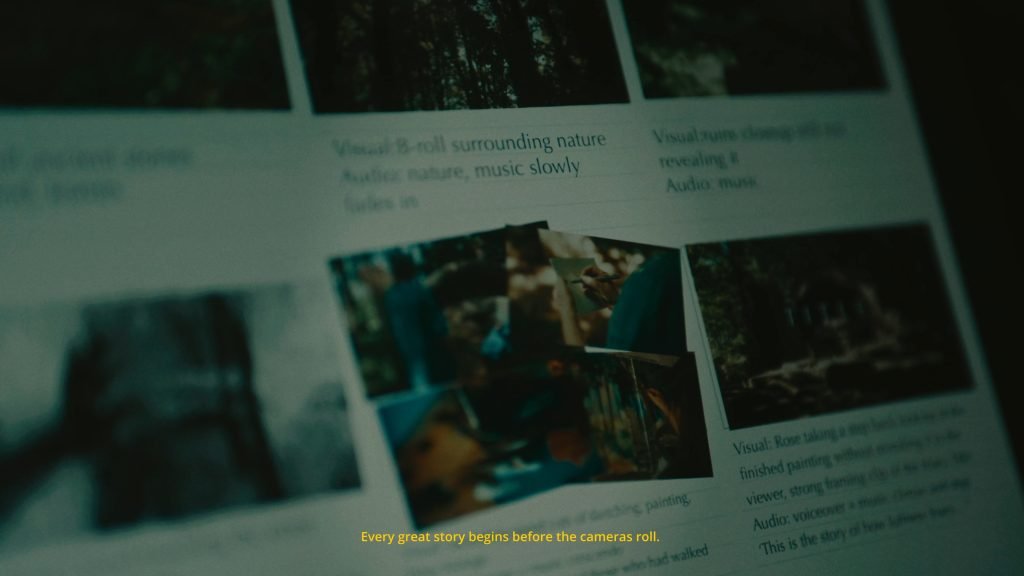
This is a methodical process used by professional editors to build a story from chaos. It prioritises story and audio before visuals, saving you an incredible amount of time.
Step 1: Get Everything Transcribed. Get all your interviews transcribed into a text document. Nowadays editing software have this capability built-in Davinci Resolve does a pretty good job at this, if your software can’t do it there are online AI tool that can help, but in both cases check it for accuracy. You can also manually transcribe it or hire a professional to do it for you.
Step 2: Create “Interview Selects.” Read the transcripts and highlight all the best quotes. Now, go into your editing software and pull only those quotes into a new timeline. Group them by theme (e.g., “Childhood,” “The Accident,” “Hopes for the Future”).
Step 3: Build “Spine 1” (The Radio Edit). Create a new, blank timeline. Using only the audio from your “Interview Selects,” arrange the quotes to tell a logical, emotional story. This is your “radio edit.” It should sound like a compelling podcast. Be ruthless. Go from 40 minutes of selects down to 5-6 minutes.
Step 4: Refine the Spine. Listen to your audio-only spine. Does the pacing work? Are there moments that need to breathe? Add intentional gaps of silence. Add temporary music to get a feel for the rhythm.
Step 5: The Rough Cut (Add B-Roll). Only now do you add your visual B-roll. Lay your B-roll shots over the audio spine to cover the gaps and illustrate what is being said. Because your story and pacing are already locked, this process is creative and efficient, not aimless.
Don’t just fill your film with wall-to-wall music. Use the “diegetic sound”, the real-world sounds you recorded, to let the film breathe. The sound of a teakettle boiling, birds in the morning, or a car passing can be more powerful than any score.
You have a finished film. The battle is over, right? Wrong. Finishing the film is only half the journey.
Many filmmakers create a short “teaser trailer” before the film is finished. This is not a traditional trailer; it’s a 2-3 minute proof-of-concept to get funding or attract collaborators.
In Scotland, organisations like Creative Scotland offer funding for documentary projects. A powerful teaser and a well-written treatment are essential for these applications.
Film festivals are the traditional path to getting your work seen by an audience and by industry professionals.
Use platforms like FilmFreeway to submit your film.
Start with local Scottish festivals (Edinburgh International Film Festival, Glasgow Film Festival) and then aim for larger UK and international ones.
Having “Official Selection” laurels on your poster builds credibility for your next project.
If the festival circuit doesn’t work out, create your own premiere. This is a powerful, rewarding experience.
Rent a local independent cinema for one night. In Edinburgh, you could hire a screen at The Cameo, or the GFT in Glasgow.
Promote it heavily to your network, your subject’s community, and local press.
There is no greater reward than watching your hard work on a big screen with the very people who are in it.
Making a documentary is a marathon, not a sprint. It will test you, frustrate you, and demand more of you than you think you have. But it is also one of the most profound ways to connect with the world, to tell a story that matters, and to create a piece of art that can genuinely make a difference.
This guide provides the blueprint. The rest is your passion and your hard work.
Scotland is full of stories. Go and find one.
You’ve just read the entire filmmaker’s blueprint. You can see the passion, craft, and complex logistics required to take a simple idea and shape it into a powerful, cinematic documentary.
It’s a rewarding journey, and you don’t have to take it alone.
If you have a story in Scotland that needs to be told, whether it’s for your non-profit, your brand, or your community, and you’re looking for a professional partner to help you navigate the process, I’m here to help.
Connect with us and transform your vision into impactful visual content. Imagine the possibilities.